

How To Divide Fractions with Whole Numbers: Easy Steps That Actually Work 2026
Introduction
Have you ever stared at a math problem like ⅔ ÷ 4 and felt completely stuck? You’re not alone. Dividing fractions by whole numbers trips up students and adults alike. It’s one of those topics that seems complicated at first glance.
But here’s the good news: once you understand the basic method, dividing fractions by whole numbers becomes surprisingly straightforward. You don’t need to be a math genius. You just need a clear system that works every single time.
In this guide, I’ll walk you through everything you need to know. You’ll learn the fundamental concept, master the step-by-step process, and see plenty of examples. By the end, you’ll handle these problems with confidence. Let’s dive in and turn this challenging topic into something you can actually understand.
Understanding the Basic Concept
Before we jump into calculations, let’s talk about what dividing fractions by whole numbers actually means. This foundation makes everything else click into place.
When you divide a fraction by a whole number, you’re essentially splitting that fraction into equal parts. Think about it this way: if you have ½ of a pizza and you want to divide it among 2 people, each person gets ¼. You’re making the fraction smaller by dividing it up.
The mathematical process involves a simple trick. Instead of dividing by a whole number, you multiply by its reciprocal. This might sound complicated, but it’s actually easier than traditional division.
A reciprocal is just a flipped fraction. For whole numbers, you put the number in the denominator and 1 in the numerator. The reciprocal of 3 is ⅓. The reciprocal of 5 is ⅕. Simple as that.
This method works because dividing by a number is the same as multiplying by its reciprocal. It’s a mathematical shortcut that makes your life much easier.
The Step-by-Step Method for Dividing Fractions by Whole Numbers
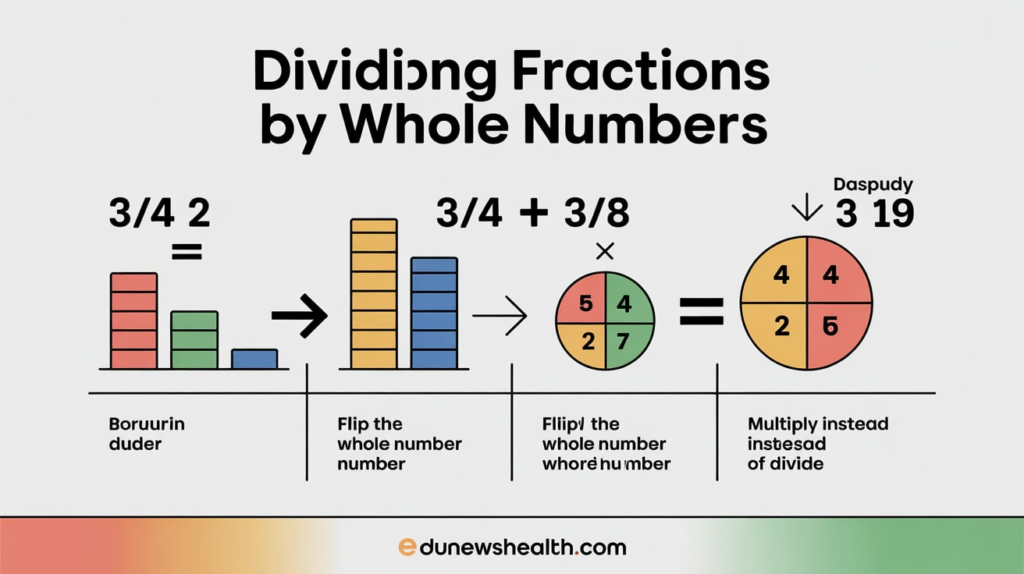
Now let’s break down the actual process. Follow these steps every time, and you’ll get the right answer consistently.
Step 1: Write Down Your Problem
Start by clearly writing out your fraction and the whole number you’re dividing by. Let’s use ¾ ÷ 2 as our example. Having everything visible helps prevent mistakes.
Step 2: Convert the Whole Number to a Fraction
Take your whole number and write it as a fraction. Put the whole number over 1. So 2 becomes 2/1. This step is crucial because you need both numbers in fraction form.
Step 3: Find the Reciprocal of the Second Fraction
Flip the second fraction (the one you’re dividing by). If you have 2/1, the reciprocal becomes ½. You’re simply swapping the numerator and denominator.
Step 4: Change the Division Sign to Multiplication
Replace the ÷ symbol with a × symbol. Now your problem reads: ¾ × ½. You’ve transformed a division problem into a multiplication problem.
Step 5: Multiply the Numerators Together
Multiply the top numbers (numerators) of both fractions. In our example: 3 × 1 = 3. This gives you the numerator of your answer.
Step 6: Multiply the Denominators Together
Multiply the bottom numbers (denominators) of both fractions. Here: 4 × 2 = 8. This becomes the denominator of your answer.
Step 7: Simplify Your Answer
Your answer is 3/8. Check if you can simplify it by finding common factors. In this case, 3/8 is already in its simplest form. You’re done!
Real-World Examples to Practice
Let’s work through several examples so you can see this method in action. Practice makes perfect with math skills.
Example 1: ⅖ ÷ 3
Start with ⅖ divided by 3. Convert 3 to a fraction: 3/1. Find the reciprocal: ⅓. Change to multiplication: ⅖ × ⅓.
Multiply numerators: 2 × 1 = 2. Multiply denominators: 5 × 3 = 15. Your answer is 2/15. This fraction can’t be simplified further.
Example 2: ⅚ ÷ 4
Begin with ⅚ divided by 4. Write 4 as 4/1. Flip it to get ¼. Rewrite as: ⅚ × ¼.
Multiply across: 5 × 1 = 5 (numerator). Then 6 × 4 = 24 (denominator). You get 5/24 as your final answer.
Example 3: 7/10 ÷ 5
Take 7/10 divided by 5. Convert 5 to 5/1. The reciprocal is ⅕. Transform to: 7/10 × ⅕.
Calculate: 7 × 1 = 7 and 10 × 5 = 50. Your result is 7/50, which is already simplified.
Example 4: ⅔ ÷ 6
Starting with ⅔ divided by 6. Make 6 into 6/1. Flip to get ⅙. Change your problem: ⅔ × ⅙.
Work it out: 2 × 1 = 2 and 3 × 6 = 18. You have 2/18. This simplifies to 1/9 by dividing both numbers by 2.
Common Mistakes to Avoid
Even with a clear method, people make predictable errors. Let me help you avoid these pitfalls before they trip you up.
Forgetting to flip the second number is the most common mistake. You must find the reciprocal of the whole number. If you multiply by the whole number directly, you’ll get the wrong answer every time.
Flipping the wrong fraction confuses many learners. Always flip the second number (the divisor), never the first fraction. Keep the original fraction exactly as it is.
Skipping the simplification step leaves your answer incomplete. Teachers often require simplified fractions. Always check if you can reduce your answer to lowest terms.
Multiplying denominators incorrectly happens when you rush. Double-check your multiplication. A small arithmetic error ruins the entire problem.
Converting whole numbers wrong creates problems from the start. Remember: any whole number becomes that number over 1. Five becomes 5/1, not 1/5.
Why This Method Works: The Math Behind It
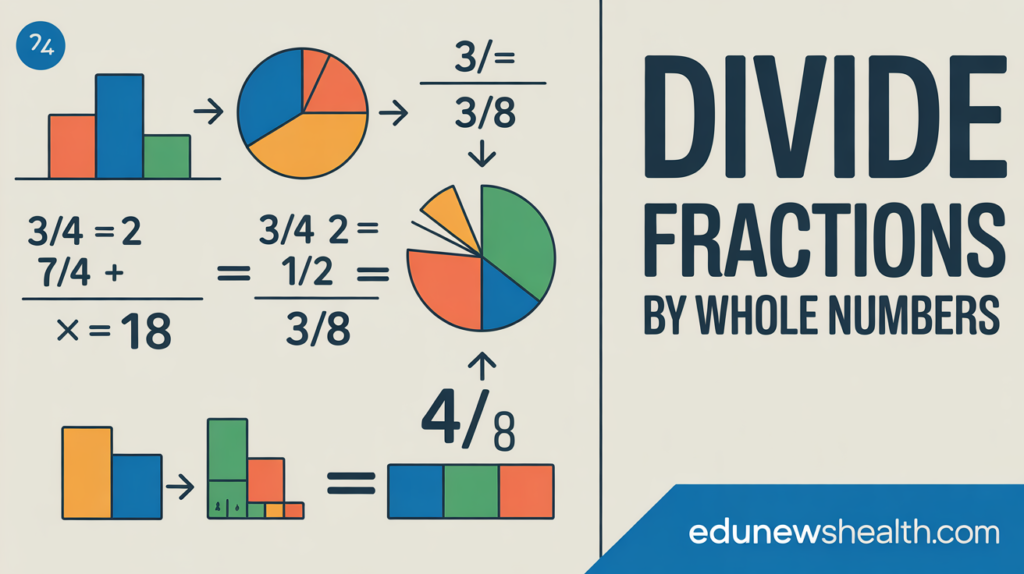
Understanding why this technique works helps cement the concept in your mind. It’s not just memorizing steps—there’s real logic here.
Division and multiplication are inverse operations. When you divide by a number, you’re essentially multiplying by its opposite. That opposite is the reciprocal.
Think about dividing by 2 versus multiplying by ½. These operations produce the same result. Dividing 10 by 2 gives you 5. Multiplying 10 by ½ also gives you 5. They’re mathematically equivalent.
This relationship extends to fractions. When you divide ¾ by 2, you’re asking: “What times 2 equals ¾?” The answer is what you get when you multiply ¾ by ½.
The reciprocal method simply takes advantage of this mathematical truth. It converts a potentially confusing division into straightforward multiplication. And multiplying fractions follows clear, simple rules.
Mathematicians developed this shortcut centuries ago. It’s proven, reliable, and universally accepted. You’re learning a method that’s stood the test of time.
Tips for Success and Faster Calculations
Want to get even better at dividing fractions by whole numbers? These strategies will boost your speed and accuracy.
Practice with flash cards helps build muscle memory. Create cards with different problems. Work through them regularly until the process becomes automatic.
Simplify before multiplying when possible. If you can reduce fractions before multiplication, your final calculations become easier. This advanced technique saves time.
Use cross-cancellation to simplify during multiplication. If a numerator and denominator share common factors, divide them out before multiplying. This keeps numbers smaller and more manageable.
Check your work with estimation. Before calculating, estimate what your answer should be. If ¾ ÷ 4, you know the answer must be less than ¾. This catches major errors.
Write neatly and organize your work. Messy handwriting leads to mistakes. Keep your fractions clearly written with horizontal fraction bars. Line up your steps vertically.
Memorize common reciprocals for faster work. Know that the reciprocal of 2 is ½, of 3 is ⅓, of 4 is ¼, and so on. This eliminates one thinking step.
Connecting to Other Fraction Operations
Dividing fractions by whole numbers fits into the bigger picture of fraction mathematics. Let’s see how it relates to other operations you might know.
Multiplying fractions uses the same numerator-times-numerator, denominator-times-denominator approach. Once you change division to multiplication, you’re using skills you already have.
Dividing by fractions (not whole numbers) follows the identical reciprocal method. Whether you divide by ¾ or by 3, you flip the second number and multiply. The process stays consistent.
Adding and subtracting fractions require different skills—common denominators. But understanding division helps you manipulate fractions confidently across all operations.
Working with mixed numbers becomes easier once you master this technique. Convert mixed numbers to improper fractions, then apply the same division method.
These operations interconnect beautifully. Master one, and the others become more accessible. You’re building a complete toolkit for fraction work.
Real-Life Applications You’ll Actually Use
Math isn’t just abstract numbers on paper. Dividing fractions by whole numbers appears in everyday situations more than you’d expect.
Cooking and baking constantly require this skill. A recipe calls for ⅔ cup of flour, but you want to make half the recipe for 4 people? You’re dividing fractions by whole numbers.
Construction and DIY projects use these calculations. If you have ⅞ of a board and need to cut it into 3 equal pieces, you divide the fraction by a whole number.
Sharing resources fairly involves this math. You have ¾ of a tank of gas and 3 people splitting the cost? You need to divide that fraction.
Medication dosing often requires fraction division. A bottle contains ⅔ of the prescribed amount, divided over 2 doses? Medical accuracy depends on correct calculations.
Time management uses these concepts. You have ⅘ of an hour to complete 4 tasks equally? You’re dividing fractions to budget your time.
These real-world connections make learning worthwhile. You’re not just passing a test—you’re gaining practical life skills.
Advanced Concepts and Next Steps
Once you’re comfortable with basic division, you can explore more challenging variations. These build on what you’ve learned.
Dividing whole numbers by fractions reverses the problem. The method stays the same: convert the whole number to a fraction, find the reciprocal of the fraction, and multiply. Just remember which number gets flipped.
Complex fractions stack fractions on top of each other. These intimidating-looking problems break down into simple division steps. The top fraction divided by the bottom fraction.
Word problems test your understanding in context. You must identify when division is needed, set up the problem correctly, and solve it. These develop critical thinking skills.
Negative fractions add another layer. The rules of positive and negative numbers apply. Negative divided by positive equals negative. Practice keeps track of signs.
Working with variables introduces algebra. The process remains identical, but you keep letters in your calculations. This connects fraction division to higher math.
Keep challenging yourself with progressively harder problems. Your confidence will grow with each success.
Teaching Others and Reinforcing Your Knowledge
One of the best ways to truly master dividing fractions by whole numbers is teaching someone else. This cements your own understanding.
Explain the steps out loud to a friend, family member, or even yourself. Verbalizing the process highlights any gaps in your knowledge. You’ll discover what you truly understand versus what you’ve just memorized.
Create your own practice problems for others. Developing questions requires deep understanding of the concept. You must know what makes a good example and how to solve it.
Use visual aids like fraction circles or bars. Drawing pictures helps visual learners grasp the concept. Seeing ½ divided by 2 become ¼ makes intuitive sense.
Share tips and tricks you’ve discovered. Maybe you found a memory device or pattern that helps. Teaching others these insights reinforces them in your own mind.
Answer questions patiently when others struggle. Explaining difficult points from multiple angles deepens your expertise. You become the go-to fraction expert.
Teaching transforms you from student to master. It’s the ultimate test and reinforcement of your skills.
Conclusion
Dividing fractions by whole numbers doesn’t have to be intimidating anymore. You now have a clear, reliable method that works every single time. Remember the core process: convert the whole number to a fraction, flip it to find the reciprocal, change division to multiplication, and solve.
Practice these steps until they become second nature. Work through the examples in this guide multiple times. Create your own problems and solve them. The more you practice, the more confident you’ll become.
This skill opens doors to more advanced math and helps in countless real-world situations. You’re not just learning for a test—you’re building practical knowledge you’ll use for years.
Ready to take your fraction skills further? Try some practice problems right now. Share this guide with anyone who struggles with fractions. And remember: every math expert started exactly where you are today.
What fraction division problem will you tackle first?
Frequently Asked Questions
Q: What’s the easiest way to divide fractions by whole numbers?
Convert the whole number to a fraction by putting it over 1. Flip that fraction to find its reciprocal. Change the division sign to multiplication and solve by multiplying straight across. This method works every time without fail.
Q: Why do we flip the second number when dividing fractions?
Flipping the second number (finding its reciprocal) transforms division into multiplication. Division by a number equals multiplication by its reciprocal—this is a fundamental mathematical property. It makes the calculation much simpler.
Q: Can you divide a whole number by a fraction?
Yes, absolutely. Convert the whole number to a fraction (put it over 1). Then flip the fraction you’re dividing by and multiply. The process is identical to dividing fractions by whole numbers.
Q: Do I always need to simplify my answer?
While not mathematically required, simplifying fractions is considered best practice. Most teachers and textbooks expect simplified answers. It makes your answer clearer and easier to understand or use in further calculations.
Q: What if my answer is larger than 1?
Some division problems result in improper fractions (numerator larger than denominator). This is perfectly correct. You can leave it as an improper fraction or convert it to a mixed number, depending on what’s requested.
Q: How do I check if my division answer is correct?
Multiply your answer by the whole number you divided by. You should get back to your original fraction. This reverse operation verifies your work and catches calculation errors.
Q: Is dividing fractions harder than multiplying them?
Not at all. Once you understand the reciprocal method, dividing fractions is actually no harder than multiplying. You’re essentially just adding one extra step (flipping the second number) before you multiply.
Q: What happens when I divide a fraction by 1?
Dividing any fraction by 1 leaves it unchanged. The reciprocal of 1 is 1, so you’re multiplying by 1, which doesn’t change the value. Your answer equals your original fraction.
Q: Can I use a calculator for dividing fractions?
Many calculators have fraction functions that handle these operations. However, understanding the manual method ensures you catch input errors and truly understand what you’re calculating. Don’t rely solely on technology.
Q: Why does dividing by a whole number make a fraction smaller?
When you divide something into more parts, each part becomes smaller. Dividing ½ by 2 means splitting that half into 2 pieces, giving you ¼. You’re distributing the fraction across multiple equal portions.
Also Read : Sad Synonym