

Central Idea Definition: Master the Secret to Powerful Writing 2026
The Heart of the Matter: A Clear Start
Have you ever finished reading an article or a book and felt completely lost? You might have enjoyed the words, but you couldn’t quite put your finger on the point. That feeling usually happens when the writer hasn’t mastered the central idea definition. It is the invisible thread that holds every sentence together. Without it, even the most beautiful prose can feel like a scattered mess of thoughts.
In this guide, we are going to dive deep into the central idea definition to help you become a more intentional writer. I’ve found that once you understand this concept, your communication becomes much sharper. We will cover how to identify it, how to write one, and why it is the most important tool in your creative kit. Whether you are a student, a professional, or a casual blogger, this is for you. By the end of this post, you will know exactly how to anchor your work. Let’s get started on making your writing more impactful and clear.
What Exactly Is a Central Idea?
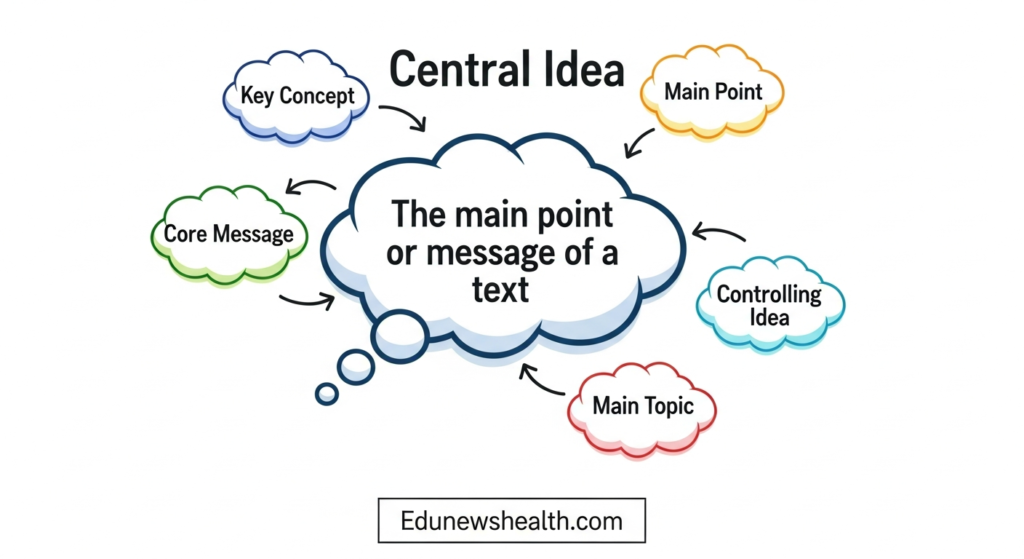
To start, we need a solid central idea definition to work with. At its simplest, the central idea is the primary point or the “big picture” of a piece of writing. It is not just the topic. A topic is broad, like “cats” or “climate change.” The central idea is the specific message the author wants you to take away about that topic. Think of it as the “so what?” of your story or essay.
I like to think of it as the compass of a story. If you are writing an essay, the central idea definition functions as your North Star. It tells the reader exactly where you are going. It also keeps you, the writer, from wandering off into irrelevant details. Every paragraph you write should serve this one main point. If a sentence doesn’t support the central idea, it probably doesn’t belong there.
When we look at the central idea definition in literature, it is often called the “main point.” In non-fiction, it is the “thesis.” Regardless of the name, the purpose remains the same. It summarizes the core message in a single, digestible thought. Understanding this helps you connect with your audience on a much deeper level.
Why the Central Idea Definition Matters to You
You might wonder why you need to obsess over a central idea definition. Can’t you just start writing and see where it goes? While “discovery writing” is a fun exercise, it often leads to confused readers. A clear central idea provides a sense of security for your audience. They want to know that their time is being spent wisely.
When you provide a clear central idea definition through your work, you build trust. Readers feel that you are a reliable guide. I have noticed that my favorite writers are the ones who stay focused. They don’t waste my time with fluff. They have a point, and they stick to it from beginning to end.
Furthermore, a strong central idea makes your work more memorable. People rarely remember every detail of what they read. However, they do remember the core message. If your central idea definition is sharp, it will stick in their minds long after they close the page. It becomes the “takeaway” that they share with others.
Benefits of a Sharp Focus
- Clarity: Your readers won’t have to guess what you mean.
- Efficiency: You will write faster because you know your goal.
- Engagement: A focused message holds attention longer.
- Organization: It acts as a natural outline for your thoughts.
How to Identify the Central Idea in Someone Else’s Work
Before you can write one, you must be able to find one. Finding the central idea definition in a text is a bit like being a detective. You have to look for clues that the author has left behind. Most authors will place the main point in a prominent spot. Check the introduction and the conclusion first.
Another trick is to look for repetition. If a writer keeps coming back to a specific concept, that’s a huge hint. Pay attention to the “pivotal” moments in the text. Often, the central idea definition is revealed when a problem is solved or a lesson is learned. I often ask myself, “What is the one sentence I would use to describe this to a friend?”
Don’t get distracted by the supporting details. Facts, statistics, and anecdotes are great, but they aren’t the main point. They are just the pillars that hold the main point up. If you strip away the examples, what is the skeleton that remains? That skeleton is your central idea definition.
The Recipe for Creating Your Own Central Idea
Now, let’s talk about how you can create one. Crafting a central idea definition for your own project doesn’t have to be scary. I usually start with a “brain dump” of everything I want to say. Once I have it all on paper, I look for the common theme. I try to boil all those thoughts down into one powerful sentence.
A good central idea should be specific but not too narrow. It should be broad enough to cover your whole piece. However, it must be narrow enough to be proven or explained in a few pages. If your central idea definition is “War is bad,” that’s a bit too simple. Try something like, “War destroys the innocence of youth and reshapes society’s values.”
Once you have your sentence, test it. Does every part of your plan fit under this umbrella? If not, you might need to adjust the sentence or cut some content. I find that this “stress test” is the best way to ensure quality. It keeps your writing tight and professional.
Step-by-Step Creation Process
- Identify the Topic: What are you writing about?
- Determine the Purpose: Why are you writing this?
- Draft a Statement: Write one sentence that combines the topic and purpose.
- Refine: Remove extra words and make it punchy.
- Align: Ensure all your sub-points support this one statement.
Central Idea vs. Topic: Know the Difference
One of the biggest mistakes people make is confusing the topic with the central idea. Let’s clear that up with a better central idea definition comparison. The topic is the subject matter. The central idea is the argument or insight about that subject. For example, “Healthy Eating” is a topic. “Healthy eating improves mental clarity and long-term energy” is a central idea.
If you only have a topic, you don’t have a direction. You are just wandering through a field of information. A central idea definition gives you a path through that field. It tells the reader why the topic matters right now. It provides context and urgency.
I’ve seen many writers struggle because they choose a topic that is too big. They try to write about “Technology” in 1,000 words. That’s impossible! But if they use a specific central idea definition, like “Artificial intelligence is changing how we learn languages,” they have a clear mission. Specificity is your best friend in writing.
The Role of Supporting Details
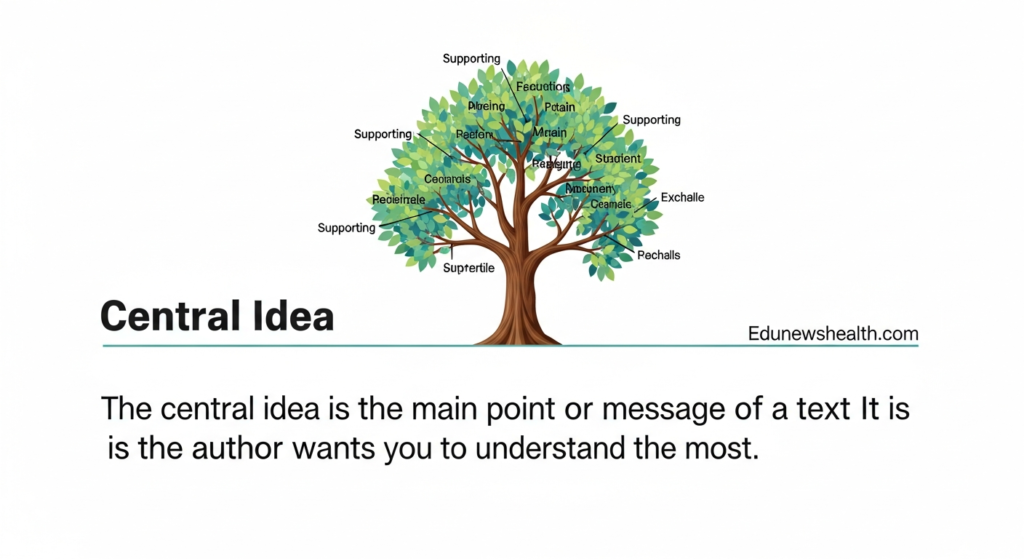
If the central idea is the heart, the supporting details are the muscles. They do the heavy lifting. You cannot have a strong central idea definition without evidence to back it up. These details can be many things. They might be personal stories, scientific data, or expert quotes.
Each supporting detail should act as a bridge. It connects the reader’s current understanding to your main point. I always tell people to think of their writing as a legal case. You are the lawyer. Your central idea definition is your opening statement. Your supporting details are the evidence you present to the jury.
Don’t overstuff your work with too many details. Choose the most “potent” ones. Quality always beats quantity when it comes to persuasion. If a detail doesn’t directly support your central idea definition, let it go. It’s better to have three strong points than ten weak ones.
Common Myths About the Central Idea
There are a few misconceptions about the central idea definition that we should debunk. First, some people think the central idea must be hidden. They think it’s “artistic” to be vague. In reality, being vague just makes people stop reading. Most successful writers are very clear about their message.
Second, some believe a central idea can only be at the beginning. While it often appears there, it can be revealed at the end as a “grand realization.” However, for most non-fiction, keeping the central idea definition near the top is best. It helps the reader follow your logic more easily.
Finally, don’t think that a central idea is the same as a summary. A summary retells the whole story. A central idea definition focuses only on the core message. I see this mistake often in student essays. A summary is about the “what,” while the central idea is about the “why.”
Applying the Central Idea in Business and Marketing
This isn’t just for English class. The central idea definition is vital in the business world too. Every marketing campaign needs a “big idea.” If you are selling a vacuum, your topic is “cleaning.” Your central idea might be, “Our vacuum gives you back your weekends by cleaning faster.”
When I work on business presentations, I always start with the main takeaway. I ask, “If my boss only remembers one thing, what should it be?” That answer becomes my central idea definition. It keeps the meeting focused and prevents people from checking their phones.
In emails, your subject line is often a hint at your central idea. If your email is a mess of different requests, people will ignore it. But if the central idea definition of the email is “We need to approve the budget by Friday,” it’s much more likely to get a response. Clear communication saves everyone time and money.
Examples of Central Ideas in Famous Works
To truly grasp the central idea definition, let’s look at some examples. In the movie The Lion King, the topic is a lion cub growing up. The central idea is that we must take responsibility for our place in the “circle of life.” Everything in the movie supports that growth.
In Martin Luther King Jr.’s “I Have a Dream” speech, the topic is civil rights. However, the central idea definition is that equality is an essential American promise that must be fulfilled for everyone. His supporting details are the vivid images of children holding hands.
Even in simple fairy tales like The Tortoise and the Hare, we see this. The topic is a race. The central idea definition is that “slow and steady wins the race.” Because this message is so clear, children have remembered it for generations. That is the power of a well-defined main point.
Practical Tips for Refining Your Voice
When you are writing, try to keep your voice natural. A central idea definition doesn’t have to sound like a textbook. Talk to your reader like a friend. Use “you” to involve them in the conversation. When I write, I imagine I’m sitting across from someone at a coffee shop.
Short sentences are your friends. They are easier to digest. They keep the rhythm of the piece moving. If you find yourself writing long, winding sentences, try to break them up. Make sure each one points back to your central idea definition. This keeps the energy high and the reader engaged.
Don’t be afraid to show some personality. You can be professional and friendly at the same time. Sharing a small personal insight can make your central idea definition feel more relatable. I’ve found that when I’m vulnerable about my own writing struggles, readers connect with me more. It builds that all-important trust.
How to Handle Multiple Ideas
Sometimes, you might feel like you have three or four main points. This is common! However, in a single article or essay, you should try to find the “Umbrella Idea.” This is a broader central idea definition that can house all your other points.
If your ideas are too different, you might actually have two separate articles. Don’t try to force them together. It will only confuse your audience. I often keep a “scrapbook” of ideas that don’t fit my current project. This way, I can use them later without ruining my current central idea definition.
Focus is a choice. It means saying “no” to good ideas so you can say “yes” to the best one. Your readers will appreciate the clarity. A focused piece of writing is a gift to the reader. It shows that you value their attention and their time.
The Connection Between Central Idea and Theme
You might hear people use “theme” and “central idea” interchangeably. While they are related, they are slightly different. A theme is usually a universal concept like “love,” “betrayal,” or “justice.” The central idea definition is the specific statement about that theme.
For example, the theme might be “friendship.” The central idea might be, “True friendship requires sacrifice during hard times.” One is a category; the other is a full thought. Understanding this distinction helps you add depth to your creative work.
When I write fiction, I often start with a theme. But as the story develops, I have to find the central idea definition. I need to know what I am specifically saying about that theme. This is what gives a story its “soul.” It’s why some books stay with you for years while others are forgotten.
Common Questions About Central Ideas
Many people ask, “Can a central idea change while I’m writing?” The answer is yes! Sometimes, you start with one central idea definition and discover a better one halfway through. That’s a natural part of the creative process. Don’t be afraid to pivot.
Another common question is, “Is the central idea always the first sentence?” Not necessarily. While it’s helpful to have it early, it can be anywhere. However, the central idea definition should be clear enough that the reader could find it if asked. It shouldn’t be a secret.
Finally, people ask, “Does every piece of writing need one?” For the most part, yes. Even a simple “How-to” guide needs a central idea definition. If the guide is about changing a tire, the central idea is “Changing a tire is a simple process that anyone can do with the right tools.” This gives the reader confidence.
Refining Your Writing Process
To master the central idea definition, you need to practice. Start small. Try writing a one-sentence summary of every movie you watch. Try to find the core message in every news article you read. The more you look for it, the easier it will be to create.
When you sit down to write your next project, don’t rush. Spend ten minutes thinking about your central idea definition. Write it at the top of your page in bold letters. Refer back to it every time you feel stuck. It will save you hours of editing later on.
I’ve found that the best writers are the best thinkers. They take the time to organize their thoughts before they share them. By focusing on the central idea definition, you are doing the hard work for your reader. You are making the information easy to consume and impossible to forget.
Summary of Key Takeaways
We have covered a lot of ground today. We defined the concept and looked at why it is so crucial for success. We explored the central idea definition in various contexts, from literature to business. We also looked at practical ways to create and refine your own main points.
Remember, the central idea is the heart of your work. It provides clarity, builds trust, and makes your message stick. Without a solid central idea definition, your writing is just a collection of words. With it, your writing becomes a powerful tool for change and connection.
I hope this guide has made the concept feel more accessible. Writing is a journey, and having a compass makes that journey much more enjoyable. Keep practicing, keep refining, and don’t be afraid to let your unique voice shine through your central idea definition.
Conclusion
Mastering the central idea definition is one of the most rewarding things you can do for your writing. It takes you from being a “word generator” to being a true communicator. It allows you to lead your readers through complex ideas with ease. I encourage you to look at your current projects. Do they have a clear core? If not, take a moment to find one.
Do you have a favorite trick for staying focused while you write? Or perhaps a movie that you think has a perfect central idea? I’d love to hear your thoughts! Sharing your experiences helps everyone in this community grow. Let’s keep the conversation going and help each other become the best writers we can be.
FAQs
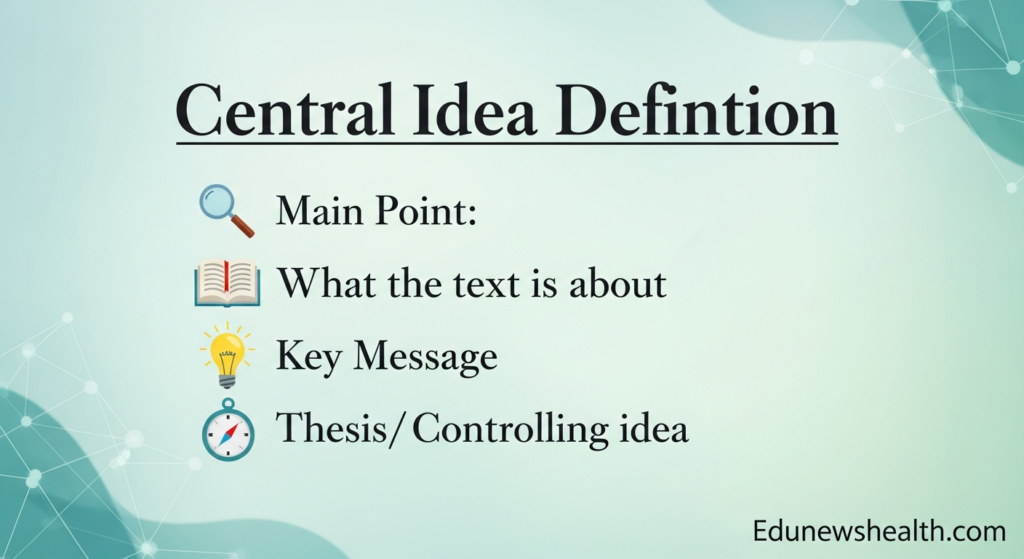
1. What is the simplest central idea definition? The simplest central idea definition is that it is the main point or the core message of a piece of writing. It is what the author wants the reader to remember most.
2. How long should a central idea be? Ideally, a central idea should be a single, clear sentence. While the concept can be complex, you should be able to summarize it briefly to ensure clarity.
3. Can a book have more than one central idea? Longer works like novels can have multiple layers, but they usually have one overarching central idea definition that ties everything together. Sub-plots may have their own minor central ideas.
4. Where is the central idea usually found? It is most commonly found in the introduction (as a thesis statement) or the conclusion. However, it is woven throughout the entire text.
5. Why is it called a “central” idea? It is called “central” because everything else in the writing revolves around it. It is the center of the “web” of information you are providing.
6. Is the central idea the same as the title? Not always. The title is meant to grab attention, while the central idea definition is meant to explain the core message. They should be related, but the central idea is more detailed.
7. How do I know if my central idea is too broad? If you find yourself writing about too many different things or feeling overwhelmed, your central idea definition is likely too broad. Try to narrow your focus to one specific insight.
8. Does the central idea have to be a fact? No, it is often an opinion, an argument, or an observation. It is the “truth” that the author is trying to convey through their work.
Also Read ; Stanley 2 Gallon Water Jug